Monday, April 4, 2011
Saturday, January 29, 2011
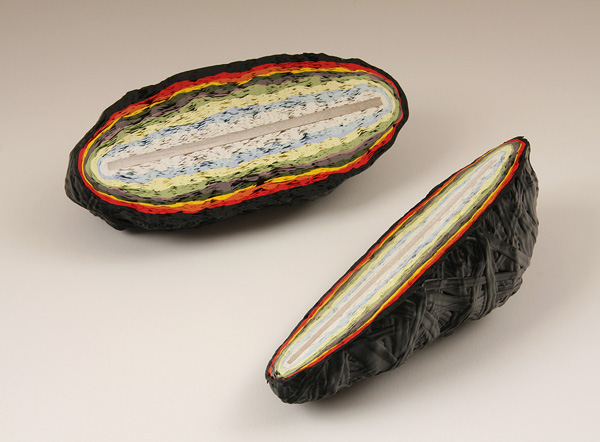
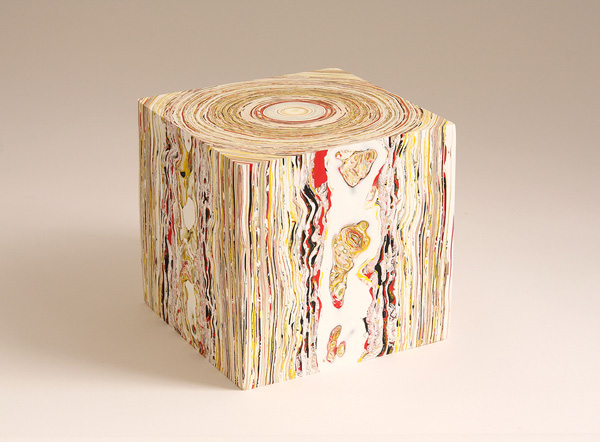
Margie Livingston's Painting Sculptures
Saturday, January 15, 2011
What is the Purpose of Painting?
For the new semester of BFA we received a questionnaire that contained questions about our practice and what we believed art and painting was. The question of "What is the Purpose of Painting" is one you hear constantly today as a painter--it is as if we must continually validate our existence and love of painting. Here is my take on the question:
" The purpose of painting is to cover surfaces in color. I think of painting as much more expansive than the artist in his studio with brushes and work on an easel. Painting is every bit of colored applied upon the surface of objects that alters them from their local colors. It is the human desire for objects to obtain color where there had been none prior. The walls of our houses, the surfaces of consumer products, and how everyone wants a specific color of car are types of painting. In fact, any use of color to coat a surface is painting. The strength of the high art version of painting compared to these other forms lies in its being hand manipulated rather than applied by a machine. Yet, understanding how saturated our contemporary lives are with painted surfaces (even if they aren’t canvases) can help painters realize the vitality and relevance of their art form. Some painters who wish to use painting to record events or to tell a story struggle to find their place today because digital, print, and video media hold so much dominance. Thus they emphasize painting’s long history and its lo-fi nature; which is a great strategy and I love the results very much. However, this competition is only a problem for the painter if he wishes for painting to function as media rather than the practice of an insatiable desire to cover surfaces in paint and color. I think limiting painting as a 2 dimensional medium is a mistake. I hope to reflect this idea in future plans to create installations that will include both panel paintings but also painted 3d objects (in particular sound equipment)."
Everyone knows that all art is not painting. But I think that it is equally important to recognize that the vast majority of painting is not art. If we can realize the importance of paint in our everyday lives we can free ourselves of this superstition that painting is outdated and see how our practice remains relevant. I'm curious to hear others' thoughts on this position.
" The purpose of painting is to cover surfaces in color. I think of painting as much more expansive than the artist in his studio with brushes and work on an easel. Painting is every bit of colored applied upon the surface of objects that alters them from their local colors. It is the human desire for objects to obtain color where there had been none prior. The walls of our houses, the surfaces of consumer products, and how everyone wants a specific color of car are types of painting. In fact, any use of color to coat a surface is painting. The strength of the high art version of painting compared to these other forms lies in its being hand manipulated rather than applied by a machine. Yet, understanding how saturated our contemporary lives are with painted surfaces (even if they aren’t canvases) can help painters realize the vitality and relevance of their art form. Some painters who wish to use painting to record events or to tell a story struggle to find their place today because digital, print, and video media hold so much dominance. Thus they emphasize painting’s long history and its lo-fi nature; which is a great strategy and I love the results very much. However, this competition is only a problem for the painter if he wishes for painting to function as media rather than the practice of an insatiable desire to cover surfaces in paint and color. I think limiting painting as a 2 dimensional medium is a mistake. I hope to reflect this idea in future plans to create installations that will include both panel paintings but also painted 3d objects (in particular sound equipment)."
Everyone knows that all art is not painting. But I think that it is equally important to recognize that the vast majority of painting is not art. If we can realize the importance of paint in our everyday lives we can free ourselves of this superstition that painting is outdated and see how our practice remains relevant. I'm curious to hear others' thoughts on this position.
Saturday, December 4, 2010
Indiana University-Los Angeles: Photos from the BFA Fall Semester 2010!
Here's a cross post of mine on a blog set up by my old professor Chris Barnard with a ton of photos from my first official BFA painting show:
Indiana University-Los Angeles: Photos from the BFA Fall Semester 2010!: "HEY CHRIS! The show was awesome! Here is an absurdly large number of photos! Installation shots: Emi had an awesome idea to hang a ..."
Good photos of current work coming soon!
Indiana University-Los Angeles: Photos from the BFA Fall Semester 2010!: "HEY CHRIS! The show was awesome! Here is an absurdly large number of photos! Installation shots: Emi had an awesome idea to hang a ..."
Good photos of current work coming soon!
Sunday, November 7, 2010
Sunday, October 24, 2010
Crappy Photos of some New Finished Paintings
Wednesday, August 11, 2010
Isao Hashimoto - "1945-1998"
http://www.ctbto.org/specials/1945-1998-by-isao-hashimoto/
""This piece of work is a bird's eye view of the history by scaling down a month length of time into one second. No letter is used for equal messaging to all viewers without language barrier. The blinking light, sound and the numbers on the world map show when, where and how many experiments each country have conducted. I created this work for the means of an interface to the people who are yet to know of the extremely grave, but present problem of the world."
Sunday, August 8, 2010
Friday, June 11, 2010
IU BFA Blog
Please follow the IU BFA Crew blog, recently set up by my Ceramicist friend Ben Cirgin:
http://iubfacrew.blogspot.com/
This is a blog for all IU BFA's (currently mostly ones that got in last semester [aka my generation]) to make posts on whatever they happen to be working on/interested in. Along with certainly lots of fun stuff other stuff; I'm sure it will be a great place to get the most recent news for openings in Bloomington.
http://iubfacrew.blogspot.com/
This is a blog for all IU BFA's (currently mostly ones that got in last semester [aka my generation]) to make posts on whatever they happen to be working on/interested in. Along with certainly lots of fun stuff other stuff; I'm sure it will be a great place to get the most recent news for openings in Bloomington.
Sunday, June 6, 2010
Currently Reading...
Tuesday, June 1, 2010
Whistler's "Gentle Art of Making Enemies"
Been reading "The Gentle Art of Making Enemies: As Pleasingly Exemplified in Many Instances, Wherein the Serious Ones of this Earth, Carefully Exasperated, Have Been Prettily Spurred on to Unseemliness and Indiscretion, While Overcome By an Undue Sense of Right" by the 19th century James Whistler American ex-pat painter living in Britain. Containing biting essays and correspondences between himself and his critics written in 19th century holier-than-thou prose, the book is both a thoroughly entertaining read as well as an interesting view into the art world and critical consensus of the time. Also, Whistler owns on fools that try to step to him:
"Critic's Analysis
In the "Symphony in White No. III", by Mr. Whistler there are many dainty varieties of tint, but it is not precisely a symphony in white. One lady has a yellowish dress and brown hair and a bit of blue ribbon, the other has a red fan, and there are flowers and green leaves. There is a girl in white on a white sofa, but even this girl has reddish hair; and of course there is the flesh colour of the complexions.
-P.G. Hamerton, June 1867
The Critic's Mind Considered
How pleasing that such profound prattle should inevitably find its place in print! "Not precisely a symphony in white... for there is a yellowish dress... brown hair, etc.... another with reddish hair... and of course there is the flesh colour of the complexions."
Bon dieu! did this wise person expect white hair and chalked faces? And does he then, in his astounding consequence, believe that a symphony in F contains no other note, but shall be a continued repetition of F, F, F.?...... Fool!
-Whistler"
Wednesday, April 28, 2010
A Suggestion...
Lying in the sun, face it with eyes closed.
Stare at the back of your eyelids as intensely as you would a delicate still life.
Focus, observe the pure color of abstract observation.
Experiment with using one hand to block sunlight from one eye, the other, or both. Different distances can block more or less light.
Squeeze your eyes closed tighter for an explosion of new color.
Open your eyes, just slightly slightly and observe the bright unfocused white patterns of light reflecting on your eye lashes set against the blue of the sky, with the hood of your eyelid weighing over it all.
Open your eyes completely and stare at a tree or some other object for a few minutes. Then return to your eyes closed facing the sun and observe the silhouetted fragments of pure color.
Do these things for at least an hour.
Stare at the back of your eyelids as intensely as you would a delicate still life.
Focus, observe the pure color of abstract observation.
Experiment with using one hand to block sunlight from one eye, the other, or both. Different distances can block more or less light.
Squeeze your eyes closed tighter for an explosion of new color.
Open your eyes, just slightly slightly and observe the bright unfocused white patterns of light reflecting on your eye lashes set against the blue of the sky, with the hood of your eyelid weighing over it all.
Open your eyes completely and stare at a tree or some other object for a few minutes. Then return to your eyes closed facing the sun and observe the silhouetted fragments of pure color.
Do these things for at least an hour.
Monday, April 26, 2010
Today I got accepted into the BFA painting program...
BLAHAHAHAHAHAHAHAHAHAHAHAHAHAHAHAHAHAHAHAHA
VICTORY IS MINE!
VICTORY IS MINE!
Wednesday, April 14, 2010
Friday, April 2, 2010
Godfrey Reggio's Koyaanisqatsi (1982)
Directed by Godfrey Reggio and scored by Philip Glass, this movie that combines slow motion and time lapsed footage creates a dialogue between the sublimity of nature, but also of the technological age (and man's small, yet greatly effected position within it).:
http://www.youtube.com/watch?v=Sps6C9u7ras
(you'll have to excuse the intrusive youtube ads, but, hey, it's free!)
Hauntigly beautiful.


http://www.youtube.com/watch?v=Sps6C9u7ras
(you'll have to excuse the intrusive youtube ads, but, hey, it's free!)
Hauntigly beautiful.
Thursday, March 25, 2010
Thursday, March 11, 2010
Jefferson Pinder
Excited for Jefferson Pinder's lecture tomorrow.
Lazarus from Jefferson Pinder on Vimeo.
He is a video, installation, and sculpture artist who works with themes of African American identity. I most appreciate his videos, which are often accompanied by extremely good music selections from hip-hop, African, Blues, and Latin sources. They effectively retain viewer interest while creating metaphors of struggle.
Thursday, February 25, 2010
Subscribe to:
Posts (Atom)